
The economic base is already significant
The Philippine Statistics Authority measured the country’s digital economy at ₱2.74 trillion in 2025, equivalent to 9.8% of GDP. It also reported 10.39 million people employed across the digital economy. AI adoption is therefore landing inside an economy where digital services, commerce, infrastructure, and work are already deeply connected.[1]
Policy is shifting toward a whole system
The National AI Strategy Roadmap 2.0, launched in 2024, incorporated generative AI, ethics, governance, research investment, talent, data strategy, and industry adoption. DOST later advanced a National AI Strategy for the Philippines with a whole-of-nation frame extending through 2028.[2][3]
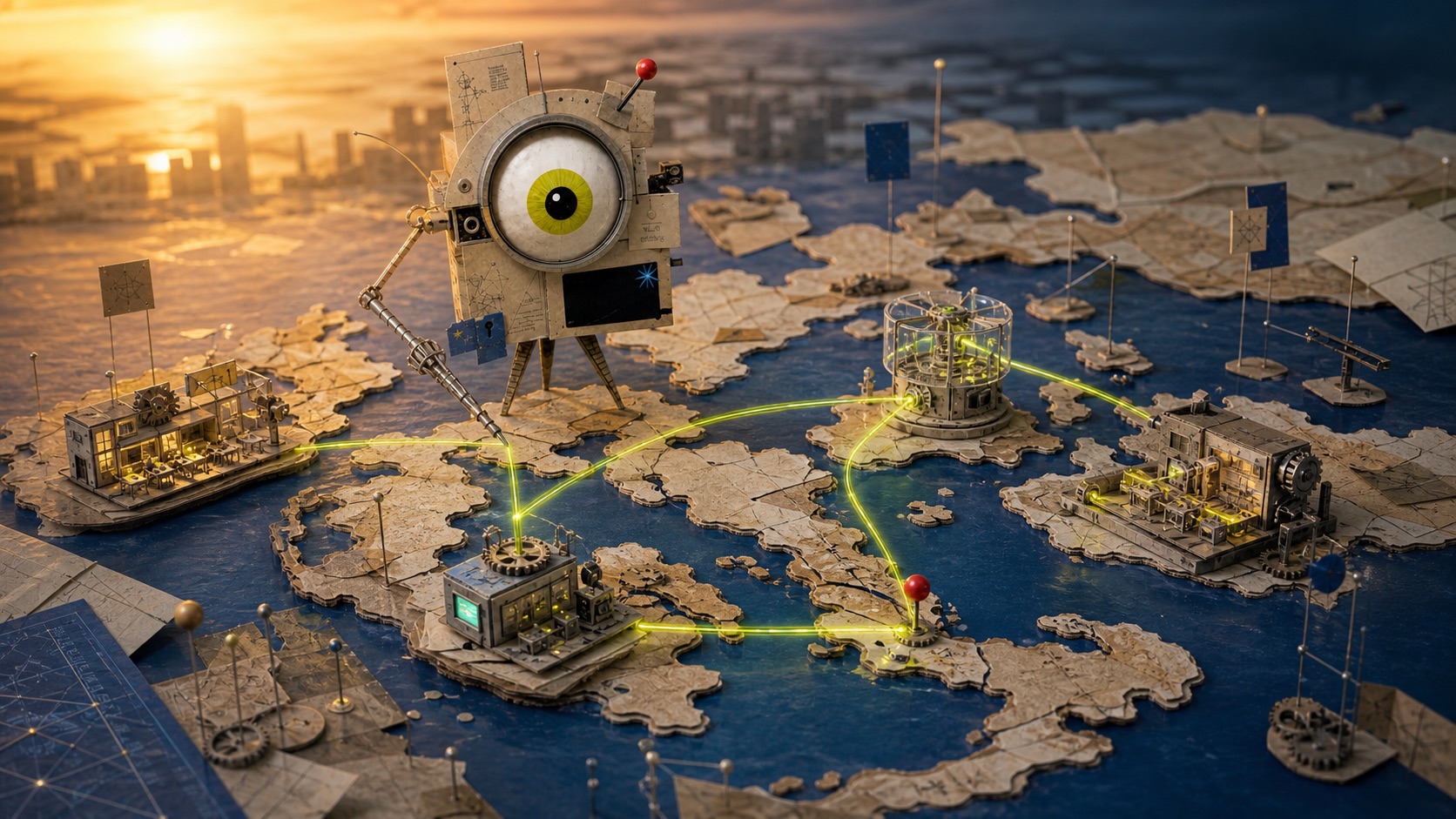
The important shift is from treating AI as a sector trend to treating it as connected national capability: compute, research, datasets, talent, governance, standards, public services, industry deployment, and international cooperation.
Public investment is becoming more concrete
In August 2026, DOST-PCIEERD said it had supported 47 AI projects worth ₱1.6 billion as of 2025, across areas including health, education, transportation, environment, disaster risk reduction, and industry. This is not one monolithic program; it is a portfolio of research and application efforts.[4]
The February 2026 launch of NAICRI added an institutional anchor intended to connect infrastructure, data, models, research, governance, and paths to deployment.[5]
AI is moving into resilience and public infrastructure
DOST and JICA began a 2026 collaboration around the GATES program, which aims to integrate fragmented geospatial and climate data into a trusted ecosystem for disaster risk reduction and data-driven governance. It is a strong example of AI as infrastructure rather than a standalone chatbot.[6]
For companies, the lesson is transferable: high-value AI often begins with data interoperability, shared definitions, reliable access, and operating responsibility before it reaches a predictive or generative interface.
International cooperation is accelerating
In August 2026, DOST and the European Union highlighted cooperation opportunities in AI infrastructure, digital transformation, responsible and human-centric AI, research, and industry collaboration. International partnership can increase access to expertise and standards, but local institutions still have to translate it into Philippine capability.[7]
What Philippine business leaders should do now
The national story creates opportunity, but no strategy document can choose a company’s first workflow. Business leaders need a portfolio view: a few high-value operational problems, a shared governance baseline, and a way to move promising experiments into production without creating shadow systems.
- Map where decisions, delays, and repeated information movement create economic friction.
- Fix access, quality, ownership, and privacy for the minimum data needed by the first use cases.
- Define an autonomy policy that connects system permissions to consequence and risk.
- Fund product and integration work around the model, including controls and measurement.
- Partner with local research, talent, and builder communities where the problem benefits from Philippine context.
The next phase should be judged by staying power
The Philippines does not need to imitate every global AI launch. It needs systems that understand local conditions, improve real work, protect people, and continue operating after the pilot. The national momentum is real. The work now is to turn momentum into institutional and operational memory.