
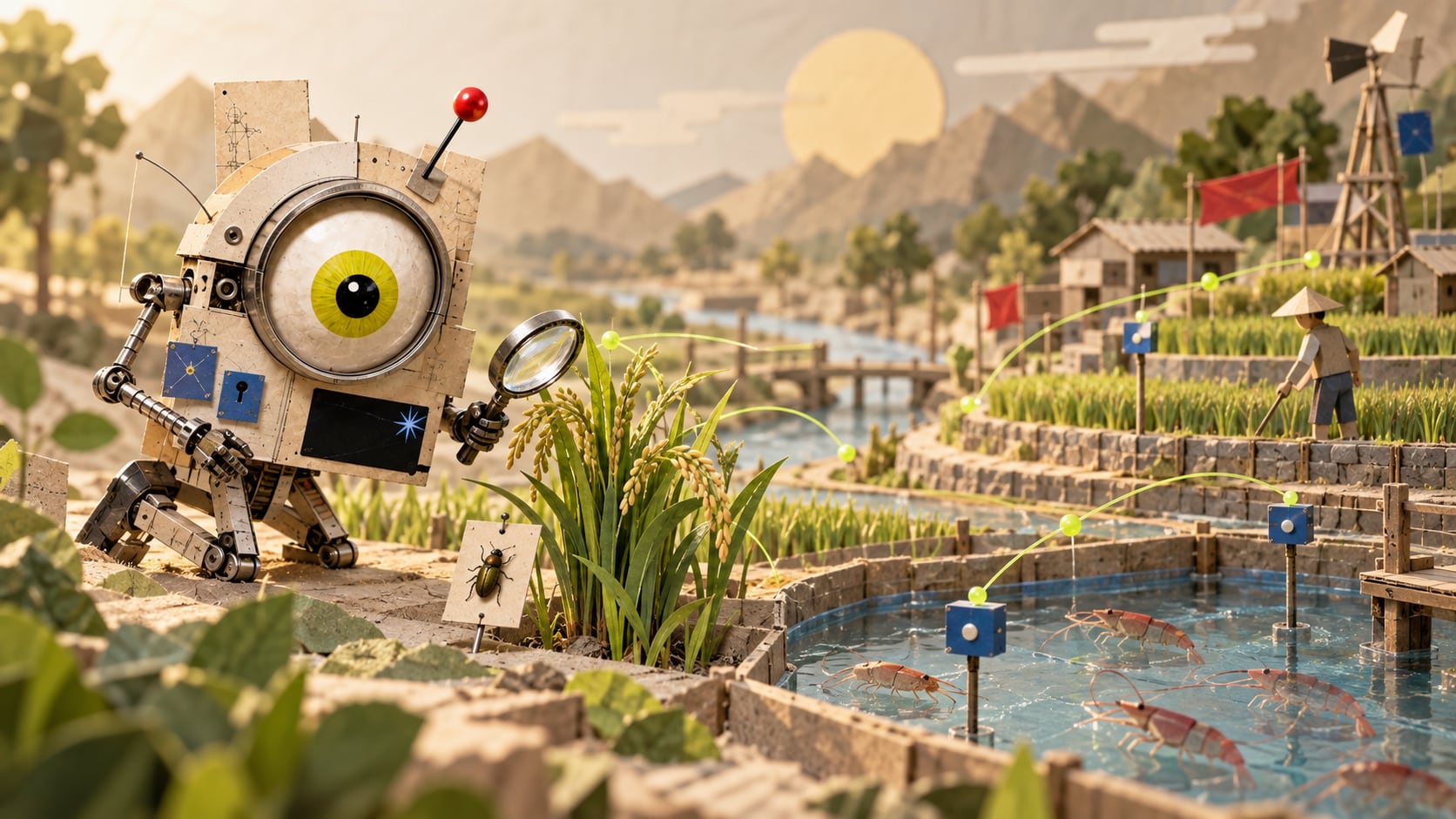
Read the portfolio as a chain of decisions
Agricultural AI becomes useful when an observation changes a decision at the right time. A farmer photographs a damaged leaf. Someone checks whether the image is usable, interprets the result and decides whether further inspection is needed. A field officer records what happened. That complete sequence is the unit worth improving.
DOST-PCAARRD’s portfolio offers examples of several links in this chain. Its September 2024 account of Project SARAi describes SPIDTECH, a phone-based application using machine learning to identify crop pests and diseases. A separate July 2025 account describes pond monitoring and hatchery equipment. The technologies should be assessed individually, with their reported dates and purposes kept visible.[1][2]
Pest recognition needs a route for uncertain cases
PCAARRD reported that SPIDTECH includes a pest and disease reference library and was available on Android when its article appeared. The same account identifies UPLB as SARAi’s implementer, supported by collaborating universities and government agencies. It does not provide evidence that every Philippine crop, locality or camera condition performs equally well.[1]
Kooya’s implementation view is to define the next action before choosing an accuracy target. An unclear image could trigger another photograph or an extension-worker review. A result outside the supported crop set should take a separate path. A pilot should record unresolved cases so the team can see whether the system reduces work or merely moves uncertainty to someone else. These are proposed operating choices, not claims about SPIDTECH’s existing design.
Keep sensors, automation and AI distinct
The July 2025 aquaculture report describes i-POND as a LoRaWAN-based water-quality monitoring system that can activate pumps and aerators. It describes HATCH as temperature-control equipment for milkfish broodstock tanks. The report discusses development and potential commercialization; it does not establish that either technology uses machine learning.[2]
This distinction matters when planning spending. A farm may first need dependable measurements, equipment servicing or a clearly configured alert. Adding a model changes the problem only if there is a decision that existing controls cannot handle adequately. Ask a supplier to identify which component learns from data, what it predicts, and which actions remain controlled by a person or a conventional rule. That makes a proposed AI addition easier to evaluate.
Shared agricultural data is an integration task
The PCAARRD-funded AgriDataCollab Microsummit took place on 29–30 April 2025 and was reported in August. It brought together government and academic data stakeholders to discuss collection, sharing and coordination. The agency’s account acknowledges continuing gaps rather than presenting a completed national data system.[3]
For a practical project, data coordination starts with ordinary questions. Does a farm identifier mean the same thing across records? When was a measurement taken? Can a field worker correct an entry? Who can authorize access? A model may process a spreadsheet successfully while silently combining incompatible observations. Agreeing on definitions, permissions and correction procedures can therefore be a larger piece of integration work than preparing the first demonstration.
A research presentation is a starting point for diligence
A March 2026 PCAARRD article about the 2025 National Science and Technology Week describes coconut hyperspectral-imaging research and a fishpond-lease monitoring platform connected to TALA Isdaan. These examples broaden the portfolio beyond a single AI application, but a conference presentation does not establish commercial availability or adoption at scale.[4]
An interested cooperative or business can use such announcements to prepare better questions: which version can be evaluated, who supports it, what equipment is necessary, and which results were measured in comparable conditions? Keep the article’s publication date separate from the event date. A recently posted story may describe an older demonstration; the age of the underlying evidence affects what should be checked next.
Extension support belongs in the operating design
PCAARRD’s 2023 policy brief on institutionalizing integrated crop monitoring and forecasting discusses how agricultural personnel and regional arrangements could connect scientific information with farmer advice. Its policy proposals are useful evidence of the institutional challenge, not proof that every envisioned arrangement has been implemented.[5]
Kooya’s analysis is that a service needs a named recipient for questions after the screen displays a result. Specify who reviews difficult cases, how they receive the supporting image or measurement, and how the farmer learns the outcome. If a pilot adds an inbox that nobody has time to monitor, faster identification may still leave the underlying field problem unresolved. Count the time required from extension staff when assessing the complete workflow.
Choose a small field decision and measure the whole cost
A useful first evaluation might cover one crop, one locality and one decision, with the scope agreed by the participating specialists. Record the existing process before introducing the tool. Track how often an observation leads to a timely, appropriate next step, how many cases require correction and whether users can understand the information presented.
Include the less visible work: charging devices, replacing sensors, checking measurements, explaining alerts and maintaining records. Test what happens when connectivity disappears or the assigned reviewer is unavailable. These are Kooya’s proposed pilot questions. They are not published DOST acceptance rules, and they do not imply that the cited projects have omitted this work.
The pilot evaluation guide provides a way to turn those field observations into an explicit decision about whether to expand.
Ask for evidence that matches the promised outcome
The sources reviewed establish a collection of applications, research, equipment demonstrations and coordination efforts. They do not justify a universal claim that DOST agricultural AI has increased yields by a particular amount or reached every farming community. A decision-maker should request evidence for the precise outcome being promised.
If the objective is faster escalation, measure escalation. If it is lower losses, establish how losses will be compared and which other conditions may explain a change. Document what happened to uncertain cases as carefully as successful ones. That approach gives researchers and operators a common basis for deciding whether to improve the system, extend the trial or keep its scope narrow.