
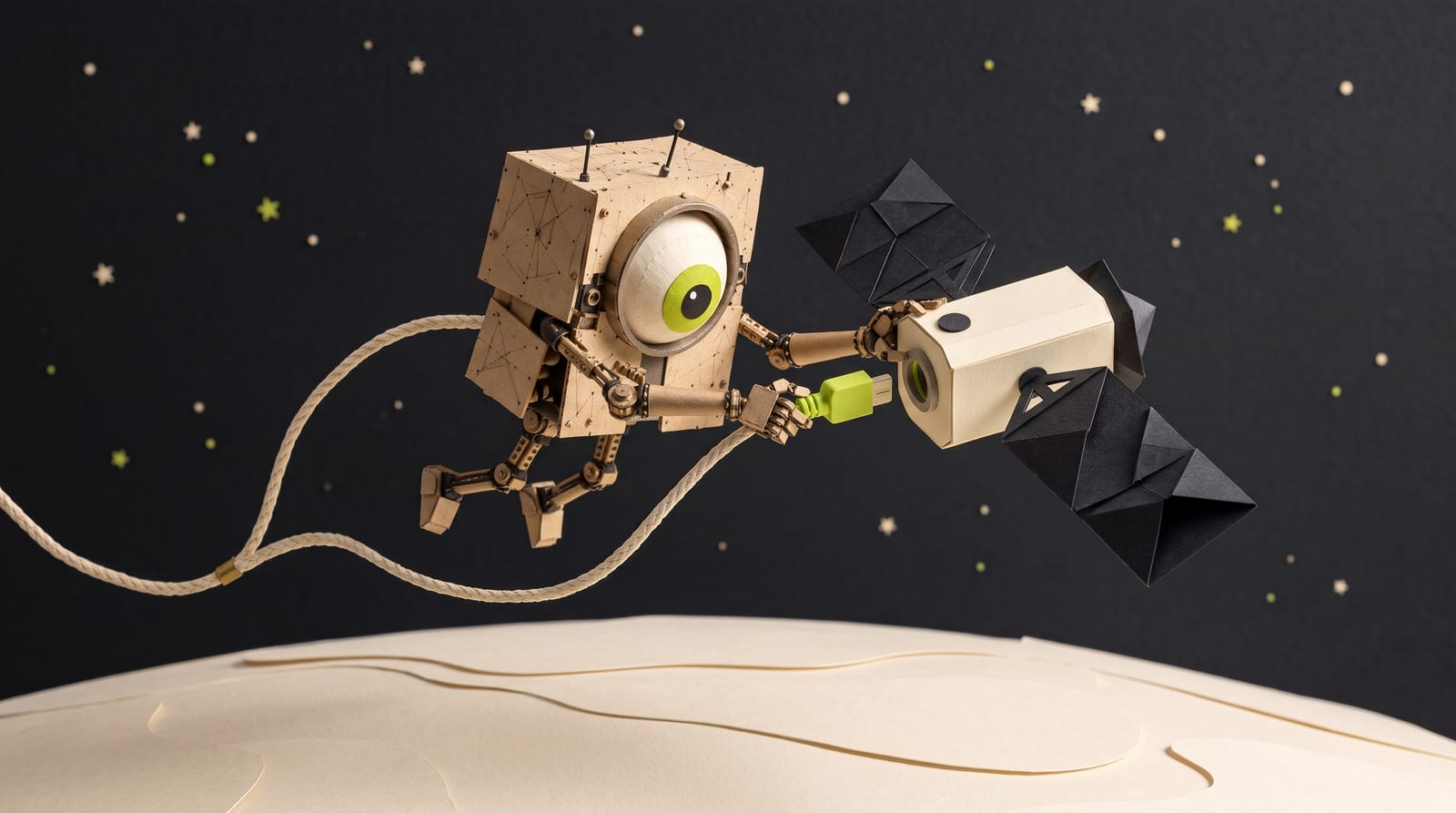
What Google reported on 30 October
Google says its Suncatcher prototype ran Gemma 4 on an onboard TPU and returned a generated poem during a ground-station pass. The company identifies thermal-stress and radiation testing as continuing work, with interconnected satellites a subsequent milestone planned for 2027.[1]
Its earlier 1 October announcement records the prototype launch with Planet aboard SpaceX’s Transporter-18 mission and confirmed contact with the spacecraft. The October launch and this week’s reported response are separate events in a research programme.[2]
The larger idea remains a research proposition
Google Research’s November 2025 description proposed solar-powered satellite constellations carrying TPUs and communicating through optical links. It presents an approach to investigating scalable computing in space, rather than a customer service specification.[3]
Kooya analysis: the new result matters because real hardware has performed a workload in its intended environment, according to the operator. That is a more concrete step than a design proposal. But it answers a narrower question than whether an orbital system can deliver dependable computing at a competitive total cost.
A useful reading discipline is to ask what uncertainty each experiment reduces. Executing a small workload can establish part of a technical chain. It does not automatically demonstrate long-duration operation, high utilisation, efficient recovery or the performance of many connected machines. Those require their own evidence.
What Philippine infrastructure buyers can learn
Kooya analysis: most Philippine organisations evaluating AI today need a service they can access, operate and support under a defined agreement. An interesting research direction belongs on a technology watchlist; it should not be substituted for the practical options in a near-term deployment decision.
The same distinction applies closer to home. A supplier’s impressive demonstration is useful evidence of one capability, but the buyer still needs to understand uptime, data handling, support and exit arrangements. Separate the demonstrated result from the broader commercial proposition, and request evidence for each consequential assumption.
For example, a hypothetical document-processing service might produce a correct answer once yet struggle with variable demand or interrupted connections. Its buyer needs a representative workload and an operating plan. This comparison concerns evaluation discipline; it does not claim that Suncatcher has been offered for document processing or tested for Philippine customers.
For a current deployment decision, compare the available options in our cloud versus on-premise AI guide.
The system boundary matters more than the headline
Kooya analysis: a future comparison of orbital and terrestrial computing would need a clearly defined boundary. Consider construction, launch, power, communication, maintenance, replacement and retirement rather than selecting one attractive resource advantage. The appropriate accounting method would depend on the service being compared.
Connectivity also belongs in the workload definition. A batch job with flexible delivery time is a different proposition from an interactive application that must respond while a person waits. Before accepting a performance comparison, ask whether it includes moving inputs to the system and returning usable results.
This article makes no estimate of costs, emissions or latency. The reviewed update does not establish those outcomes. Turning a prototype result into an economic or environmental conclusion would require additional measurements and assumptions made visible to the reader.
What evidence to watch next
Kooya analysis: the next useful disclosures would explain sustained workloads, operating conditions, failures and recovery, rather than only another successful output. For connected prototypes, published communication results would help clarify what a larger system could realistically support.
Track the distinction between a planned test and a completed result. A dated evidence log lets a team update its view when the research changes without treating every milestone as a finished product. Current infrastructure decisions can continue against known requirements while a longer-term possibility develops.
This analysis draws on Google’s public disclosures reviewed on 31 October. Kooya did not inspect telemetry, interview the researchers or conduct an independent test. The announcement supports attention to the experiment, not a claim of available Philippine capacity or a recommendation to move workloads into orbit.