Begin with the project’s present tense
The public Pino SI site describes an effort to adapt an existing open model for the Philippines. It labels research and design as in progress, and the coding pilot and evaluation as planned. Its introductory greeting is explicitly presented as a greeting, not a model demonstration.[1]
This is a Kooya research note about our own work, not an outside assessment of success. We distinguish a design choice, a future aspiration and an observed result.
Give the ambition a clear meaning
SI in Pino SI expresses our long-term superintelligence ambition. It is a statement of direction. It does not mean that Kooya has created superintelligence, demonstrated general superiority to people or established a reliable path to that outcome.
The useful present-day questions are smaller. Can a model interpret a request as the user intended? Can it produce an answer that survives a practical check? Does additional language training help on the chosen task without weakening capabilities that already matter? Those questions can generate evidence even while the long-term ambition remains open.
Adapt a foundation and study the change
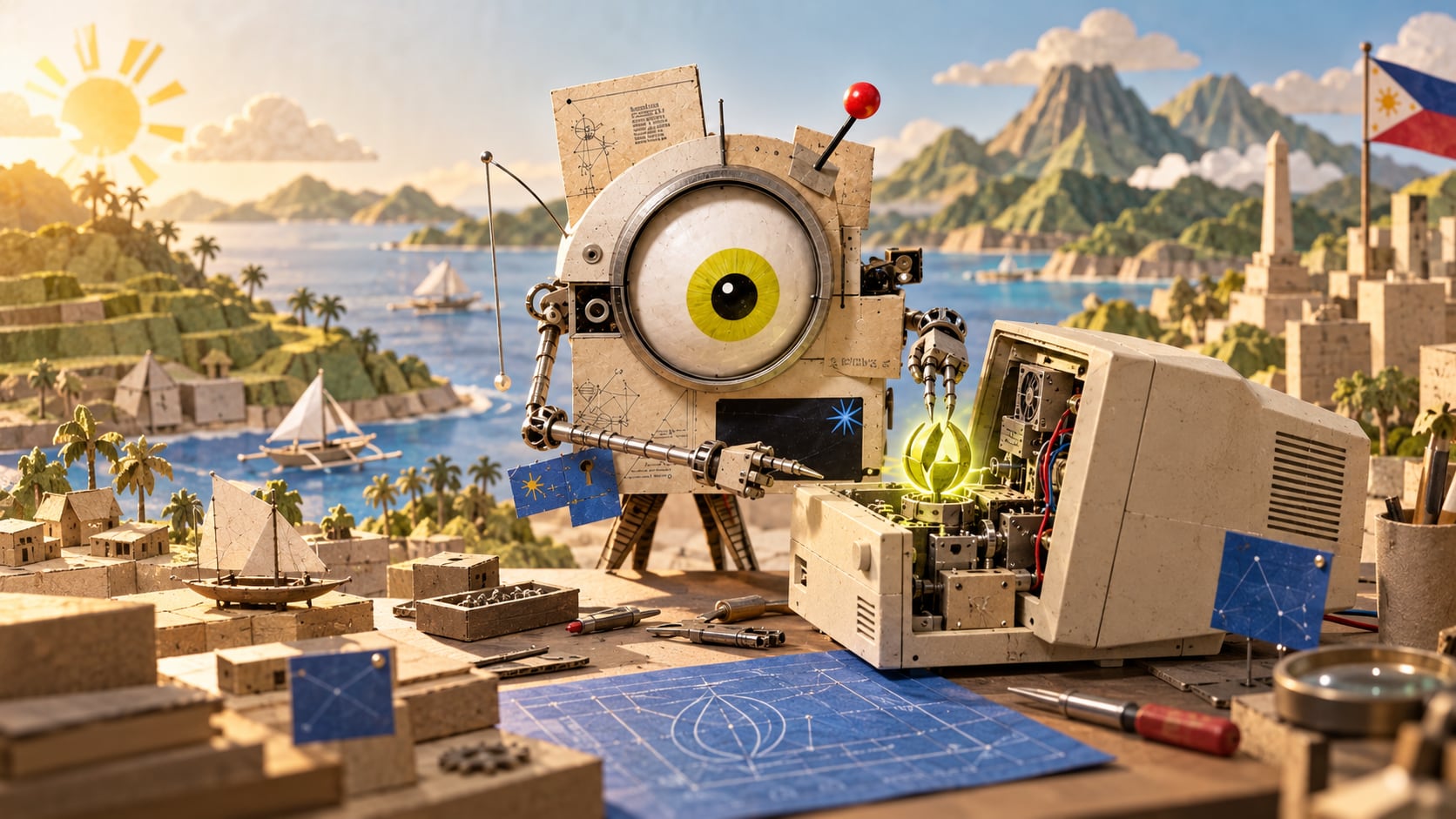
Pino SI’s published approach begins with an open model and adds Philippine-language training. A small first round is intended to help identify a useful training approach. The public plan does not announce that a model has already completed this process.[1]
Our rationale is to make the research question manageable. Starting from a foundation allows attention to focus on what an adaptation changes. It also creates a comparison point: if the adapted version behaves differently, we can investigate the benefit and the tradeoff rather than attribute every capability to the new work.
“Open” should not be read as a complete description of permissions or a guarantee of suitability. This note makes no announcement about a particular foundation, its identity or a release licence. Those choices need their own precise documentation when there is something public to report.
Make the first comparison understandable
The planned comparison uses two versions of the same model on the same coding problems. One path receives coding training; the other receives additional Philippine-language training before coding training. The published question is whether that language stage makes a difference.[1]
In our interpretation, this is a useful way to put a broad mission into a bounded experiment. The result could show improvement, no meaningful change or a tradeoff. A research design should leave room for all three outcomes, rather than assume the adaptation must help.
The planned coding comparison explores how that extra training stage could be evaluated fairly.
Use coding to connect answers with observable behavior
The public plan puts coding first because answers can be executed. That creates an observable check alongside a reviewer’s assessment of the explanation. It does not establish that Pino SI has already produced successful results.[1]
For our research rationale, execution offers a useful distinction between an explanation that sounds convincing and a program that performs the requested operation. Passing a test still depends on the quality and coverage of that test. It should not be mistaken for proof that a program is secure, complete or ready for every environment.
This is why a bounded task is valuable. It gives an evaluator something specific to accept, reject or investigate. The long-term project can remain ambitious while the immediate evidence stays concrete.
Keep language and practical usefulness connected
Pino SI’s published goal covers Tagalog, English and Taglish, with more Philippine languages over time. It also describes future small proof-of-concept work around practical tasks, suitable data, permissions and clear tests. These are planned directions, not a list of deployed services.[1]
Our view is that linguistic familiarity matters when it helps a person express the actual problem. A warm tone alone is insufficient. The model must still follow the request, preserve relevant details and handle uncertainty sensibly.
The same distinction applies to local knowledge. A locally phrased answer can be wrong, and a correct general answer can overlook the user’s context. Research needs to examine both the language of the interaction and the substance of the task.
Let the next claim be earned by the next result
The contribution of this stage is a clearly stated research question and a public distinction between planned work and completed evidence. We have not presented the site’s data figures, model-size targets or funding ambition as performance results.
For a reader following the project, the useful next evidence would be a documented experiment: what was tested, under what conditions, what changed and what remained uncertain. That is a standard for interpreting progress, not a new commitment to a particular release date or publication schedule.
Pino SI’s mission is to make room for Philippine voices in AI development. Its current work starts with adaptation and evaluation. Keeping those levels separate gives the ambition room to grow without asking readers to treat an intention as an achievement.