A plan
What the institution wants to accomplish. Look for ownership, dates and delivery dependencies.

THE SIGNAL / A KOOYA FIELD GUIDE
The people, programs and possibilities shaping what comes next. A guide to understanding it—and building something useful.
01 / THE LANDSCAPE
SOURCE REVIEW
BY KOOYA / THE SIGNAL
Philippine AI is a connected story of public infrastructure, scientific research, local languages and everyday work.
DOST’s research programs, DICT’s infrastructure agenda and DTI’s industry initiatives approach that story from different directions. Their announcements help explain national intent. The next question is what has been funded, built, tested and made available—and to whom.
For an organization, the starting point can be much smaller: a document queue, an inconsistent handoff, a customer question or a decision that needs better information. For a researcher, it may be access to compute, a well-defined language gap or an experiment that others can inspect and repeat.
This guide connects those perspectives. Use it to orient yourself, choose a reading path and move from an interesting claim to a testable next step. The illustrations are conceptual; the linked reporting supplies the evidence.
What the institution wants to accomplish. Look for ownership, dates and delivery dependencies.
An approach has been explored. Ask what was tested, on which data and against what baseline.
A bounded real-world trial. Look for users, conditions, failure cases and evaluation criteria.
A system is used in practice. Check actual coverage, monitoring, support and measured outcomes.
TWO WAYS IN / EQUAL PRIORITY
Start with the questions closest to your work, then cross over when the context becomes useful.
Start with a workflow, the people who use it and the cost of getting it wrong. Then choose the technology and decide what evidence would justify expanding it.
The Philippines’ AI momentAI workflow automationBuild vs buy AI softwareTest an AI pilot before rolloutTrace institutional responsibilities, infrastructure access and research design. Keep plans, prototypes, pilots and measured outcomes separate as you read.
DOST and DICT: plans to implementationDOST shared AI infrastructureNavigate DOST AI funding pathwaysTesting coding in English and Taglish02 / WHO IS BUILDING
Six institutional entry points into Philippine AI. A national strategy, a research center and a funding call offer different kinds of opportunity.
National AI framework connecting infrastructure, workforce, innovation, ethics and policy, and deployment.
What the evidence establishes
DOST reports presidential approval in May 2025. Framework approval does not establish that every agency or project has completed implementation.
Infrastructure agenda covering connectivity, AI computing, data centers, sustainable energy, skills and policy.
What the evidence establishes
DICT reports a September 8, 2026 launch with ADB for the 2026–2033 plan. Announced capacity and reskilling figures are targets, not completed outcomes.
Industry-facing AI strategy and research initiative addressing adoption, research, workforce, data, connectivity and ethics.
What the evidence establishes
DTI launched NAISR 2.0 and CAIR on July 3, 2024. Reviewed sources do not establish a merger with DOST’s NAIS-PH or a shared application process.
Institutional home intended to connect AI research, shared infrastructure, governance and routes from prototypes to deployment.
What the evidence establishes
NAICRI launched February 26, 2026. The April 2026 program review describes prototypes moving toward pilots; it does not establish that every component is operating at scale.
Shared research infrastructure providing high-performance computing, Science Cloud and data archiving.
What the evidence establishes
The April 28, 2026 acceptable-use policy limits access to R&D and scientific work. Accounts and allocation increases require approval; it is not unrestricted production hosting.
Research calls translate AI priorities into proposal pathways, including locally relevant applications and Philippine-language capability.
What the evidence establishes
The January 2026 document is a call for 2028 funding. A call does not prove an award, disbursement or an application window still open today.
03 / AI IN PRACTICE
AI integration becomes concrete when it meets a crop, a clinic, a weather forecast or a small business. These examples show the direction of travel and the questions still open.
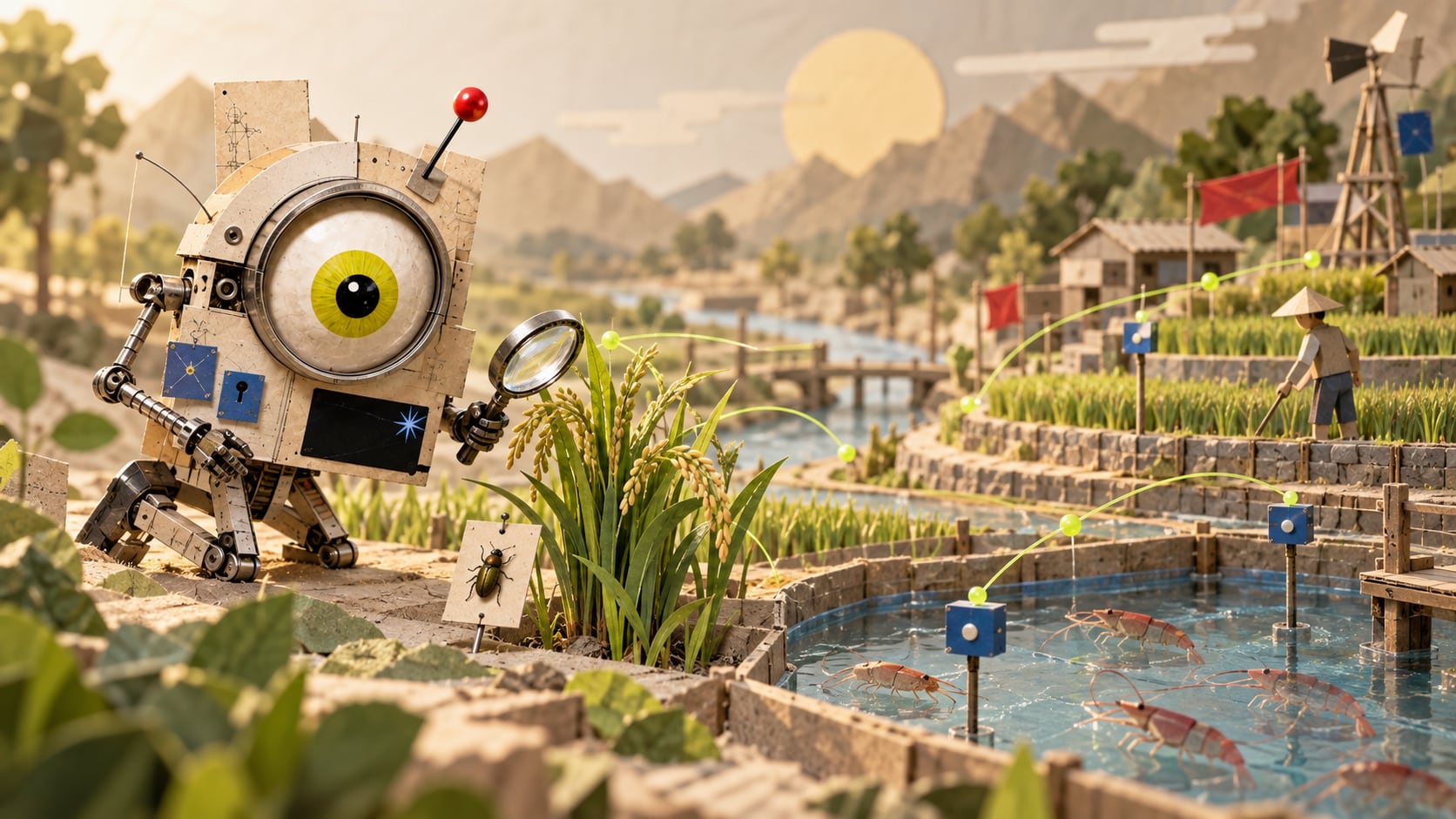
PCAARRD’s SARAi account describes SPIDTECH using machine learning to identify crop pests and diseases from phone images. Its wider portfolio also includes water monitoring and automation, which should not automatically be labelled AI. The integration question is how an observation reaches a useful field decision and an appropriate reviewer.
The source reported Android availability in 2024; it does not establish equal performance across crops, localities and camera conditions. Separate aquaculture reports discuss development and potential commercialization.
From farm data to useful decisions
AYUHON connects pediatric research problems with AI-assisted decision support: ChildMIND addresses developmental screening and intervention mapping, while CHARITY concerns childhood tuberculosis. ASTI handles execution and technology development, with PCHRD providing research guidance and funding oversight.
The April 20, 2026 kickoff establishes a launched research program, not validated diagnostic performance or nationwide clinical deployment. The October ASEAN report describes a draft action plan awaiting endorsement.
Health AI from research to workflow
The portfolio spans three jobs: PAGASA-led AI4RP supports forecasting, GATES develops shared geospatial data foundations, and Handa integrates preparedness information. Kooya’s implementation lens is to connect those layers to accountable operators, authoritative advisories and tested local procedures.
ASTI reports an AI4RP system deployed in 2024 and further verification work. Handa has launched, while the broader GATES ecosystem remains in development. These facts do not establish universal forecast superiority or nationwide operational coverage.
From AI forecasts to local response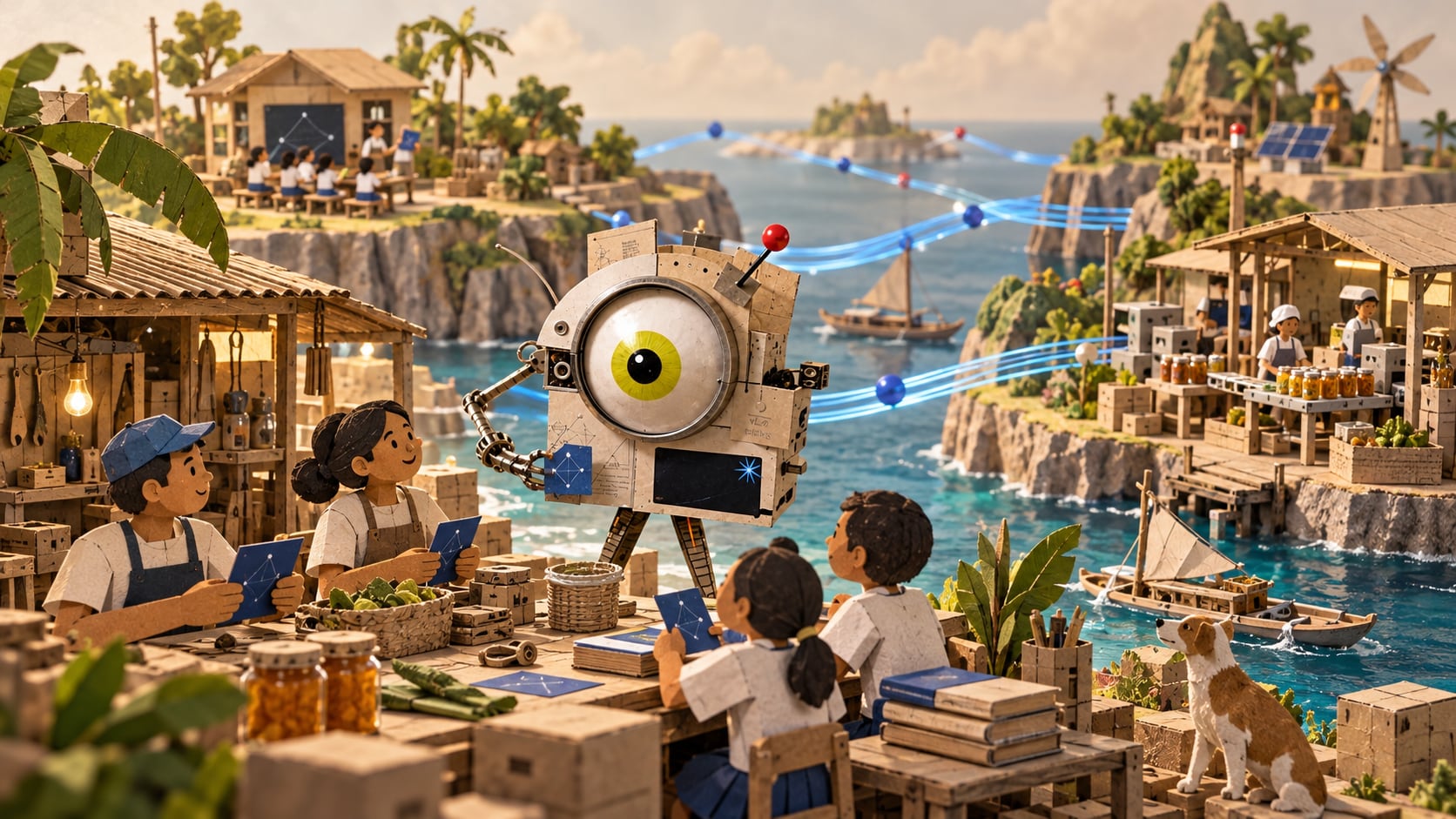
Western Visayas links an AI Development Action Plan with computing preparations, governance consultation and business engagement. AI Connect’s published program included demonstrations and business matching for entrepreneurs and MSMEs. Together these describe possible entry points for adoption, rather than measured commercial returns.
The January 2026 facility report describes pre-implementation work, not proof every planned HPC facility is operational. The advertised August 2026 AI Connect date has passed; the program is not a current registration invitation.
DOST’s regional AI adoption plan
04 / LANGUAGE & PINO SI
Language belongs in the evaluation plan. English, Tagalog and Taglish can express the same request differently; regional languages add further contexts that an English-only test cannot represent.
Pino SI is Kooya’s entry into Philippine-focused model research. Its public direction is to adapt existing open models and investigate local-language capability, starting with a carefully designed coding comparison. The proposed question: does Philippine-language training before coding training help on equivalent tasks, while retaining English capability?
That requires controlled comparisons, held-out tasks and visible failure analysis. Model size, a data inventory or an ambitious name cannot answer it on their own.
Explore the Pino SI research series ↗05 / YOUR NEXT MOVE
Kooya’s practical decision framework: use the smallest approach that can meet the need, and make the evidence strong enough to change your mind.
| Your situation | A sensible starting point | What to test |
|---|---|---|
| The work follows stable rules | Ordinary software or workflow automation. Add a model where language or judgment creates a real gap. | Exceptions, handoffs, time saved and recovery when a step fails. |
| People need answers from documents | Retrieval with an existing model, controlled source access and an explicit ‘I don’t know’ route. | Source accuracy, access controls, missing answers and out-of-date information. |
| A standard product covers most needs | A bounded buy-versus-build comparison using your actual examples. | Integration, data handling, total operating cost and the cost of leaving. |
| The workflow must take actions | A constrained agent with permission boundaries, logs and human approval where needed. | Wrong actions, duplicate work, rollback and reliable escalation. |
| A language or domain gap persists | A controlled model-adaptation experiment after evaluating simpler approaches. | Held-out quality, regressions, data rights, inference cost and reproducibility. |
FROM INTEREST TO EVIDENCE
A useful pilot is a decision instrument. These six steps are an implementation checklist, not a promise that every project needs the same timeline or architecture.
Write down the trigger, the person responsible, the expected output and what happens after it. Avoid making ‘use AI’ the objective.
Record current completion time, errors, rework and cost. Include the human effort that a demo usually hides.
Use representative, authorized examples. Include difficult cases, missing information and the language mix people actually use.
Define allowed actions, data access, reviewer responsibilities and escalation. Test how it behaves when it cannot complete the task.
Count model calls, infrastructure, integrations, support and human correction. Faster generation is useful only if the complete workflow improves.
Set success and stop criteria in advance. Document what failed, who owns ongoing monitoring and what would trigger a rollback.
A KOOYA ORIGINAL / 00:30
Our mascot explores a miniature world of research, language and connected islands.
AI-generated conceptual animation. A visual interpretation of the guide’s themes, not footage of government facilities or proof of model capability. No spoken dialogue.
A cream cardboard robot with one large lime-colored eye lowers a glowing seed into a miniature landscape. The camera follows illuminated paths between paper islands, rice terraces, houses and research buildings. The mascot adjusts a dial beside computing towers; folded-paper ribbons rise around it. The camera pulls back as the mascot waves over the connected world. Music and gentle mechanical sounds accompany the animation.
06 / QUESTIONS WORTH ASKING
Short answers to the questions that connect policy, research and implementation.
The reviewed sources describe several initiatives with different owners and purposes. DOST’s NAIS-PH, DICT’s infrastructure agenda and DTI’s NAISR 2.0 and CAIR are not interchangeable names. Identify the implementing office, current announcement, eligibility and contact route for a specific opportunity.
DOST and DICT: plans to implementationNo. A useful solution may combine an existing model, reliable business data, ordinary software and human review. Adaptation becomes a separate research or engineering decision when a defined capability gap persists after simpler approaches have been tested. Compare the ongoing evaluation and operating burden as well as the initial build.
Build vs buy AI softwareNo. SI names the ambition. Pino SI is Kooya’s Philippine-focused model research effort, with research and evaluation plans in progress. Its public direction includes adapting existing open models and testing Philippine-language capability. Planned experiments and model-size roadmaps are not validated capability results.
Pino SI Philippine AI researchChoose a specific workflow, establish its current cost and failure modes, and define a test that can show whether a pilot improves it. Language handling, permissions, human handoffs and ongoing operating costs belong in that decision.
Test an AI pilot before rolloutRead strategy, funding, facilities, pilots and deployed services as separate stages. A useful implementation question identifies the responsible institution, what is actually available and the conditions for access.
DOST and DICT: plans to implementationA task expressed in Taglish can place an important constraint in either language. Natural phrasing and correct task execution need separate checks. Pino SI’s planned research explores this problem; the current notes do not report completed model evaluations.
Pino SI Tagalog Taglish regional languagesKEEP EXPLORING
Bring a real operational question. We can help turn it into a scoped software problem, a testable pilot or a clearer decision about what to build.
Talk to Kooya ↗Institutional claims link to their sources. Practical frameworks are Kooya’s synthesis. Dates and program stages reflect the review above; check the implementing office for current access, funding deadlines and eligibility.
Our publishing process uses AI assistance, including substantially AI-generated material. Pino SI is our own research initiative. Read the editorial method for sourcing, disclosures and corrections.
Our editorial method ↗Explore government AI programs ↗Browse The Signal library ↗